Best first crops
Lettuce, basil, spinach
Easiest start
Kratky jar or 5-gal DWC
Target pH
5.5–6.5
Leafy EC
0.8–1.4 mS/cm
Must-buy tools
pH + EC meters
Watch for
Heat, light leaks, spills
What “at home” actually constrains
Home hydroponics fails less from missing gadgets and more from heat, light leaks, spills, and no meters. An apartment kitchen or spare closet can grow excellent lettuce — if you pick a system that matches your noise tolerance, floor space, and willingness to scrub a bucket.
Start with leafy greens and herbs. Skip tomatoes and big peppers until you have one clean harvest and a habit of checking pH and EC. The goal of week one is not a vertical farm; it is edible leaves without a flood on the laminate.
Pick a spot before you buy parts
You need: a waterproof floor or tray, access to an outlet (for DWC air pumps and lights), somewhere you can block light from hitting the reservoir, and temperatures that do not cook the water. Hot utility closets and sunny south windowsills without cooling are common failure zones.
Countertop kits suit kitchens. Opaque jars or buckets suit a shelf under LED bars. Keep reservoirs off radiant heaters and out of direct afternoon sun. If you rent, put everything in a shallow plastic boot tray — landlords notice water rings.
Shopping list for a first home system
Minimum that actually works: food-safe opaque container with lid, net pots, inert media (clay pebbles or rockwool cubes), complete hydroponic nutrients (A/B or a dry salt kit), pH meter with storage/calibration solution, EC/TDS meter, and a light that can hit leafy PPFD (roughly 200–400 µmol/m²/s for lettuce).
If you choose DWC, add an aquarium air pump, airline, check valve, and air stone. If you choose Kratky, skip the pump — but keep the room cool. Meters beat fancy frames. Buy those before upgrading the light.
Path A — Kratky jars (no pump)
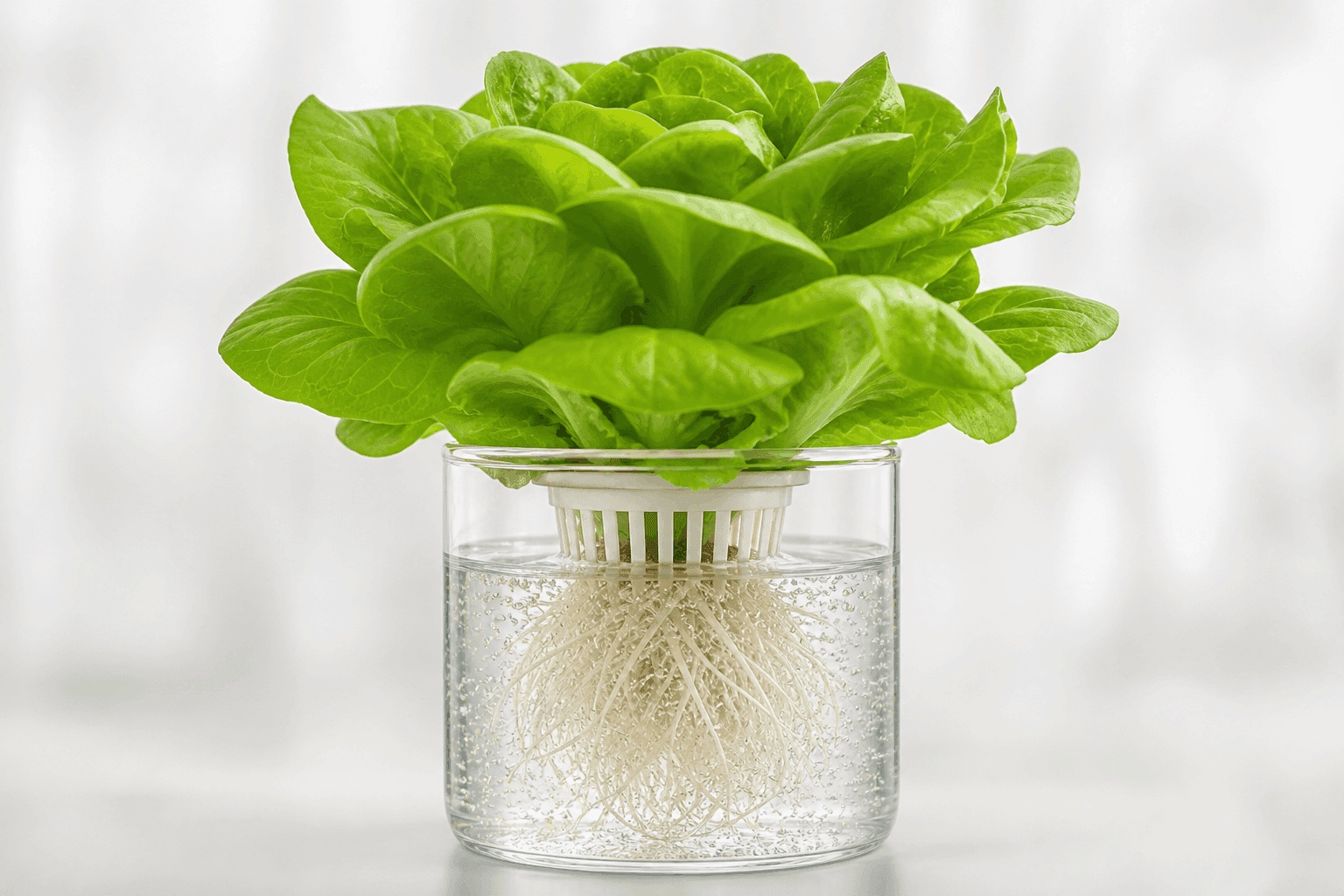
Kratky is the quiet apartment option: fill a jar or bucket so the cube/net pot touches the solution, mix nutrients once, and let the waterline fall as the plant drinks. An air gap forms around the upper roots. No bubbling, no pump hum.
It shines with lettuce and basil in cool rooms. It struggles when solution temperature climbs into the mid-70s°F (mid-20s°C) and higher. Use opaque containers, block light, and size the reservoir so it lasts to harvest without constant top-offs that erase the air gap.
Path B — Single-bucket DWC (air pump)
Deep water culture hangs roots in oxygenated nutrient solution. A 5-gallon bucket, lid with one net pot, air stone, and continuous pump is the classic DIY starter. You can lift the lid and see root health — that feedback is why DWC teaches faster than sealed countertop gadgets.
Run the air pump 24/7. Keep solution nearer 65–72°F (18–22°C) when you can. Size the stone and pump for your volume; weak bubbling in warm water is how beginners meet root rot.
Light without cooking the room
Windows alone rarely finish dense lettuce indoors year-round. A dimmable full-spectrum LED sized for a shelf or small tent is the usual home fix. Hang higher than you think, then lower until plants look compact without bleaching.
Use our hang-distance and DLI tools to sanity-check wattage and hours. Still air under a strong LED causes tip burn — a small clip fan across the canopy helps calcium move and keeps leaf edges happier.
Mix nutrients like a kitchen recipe
Fill with water, note starting EC if your tap is hard, add nutrient parts separately (never premix concentrates), stir, measure EC, then adjust pH last into roughly 5.5–6.5. For leafy greens, many home tanks land around 0.8–1.4 mS/cm once established — seedlings softer.
Top off with pH-adjusted plain water when the level drops and EC climbs. Remake the reservoir every 7–14 days (sooner in heat). Keep a towel and a tray under everything the first month; spills teach faster than blog posts.
House rules that keep you growing
Opaque lids stop algae. Food-safe plastics only. Label mix dates on tape. Calibrate the pH meter. Do not chase every yellow leaf with a new bottle — check roots, temperature, pH, then EC first.
Noise: put air pumps on a foam pad and outside a thin bedroom wall if you can. Smell: healthy DWC should not stink; foul odor means remake and scrub. Neighbors and partners care about those two more than your EC chart.
A four-week first-harvest plan
Week 0: buy meters + nutrients + either Kratky jars or one DWC bucket + a modest LED. Germinate lettuce or basil in cubes.
Week 1: transplant when roots show, mix to a gentle EC, confirm pH, set light 12–16 hours. Check meters daily.
Weeks 2–3: top off with water as needed, watch roots, keep the reservoir cool and dark. Do not “help” with random boosters.
Week 4+: harvest outer leaves or whole heads, remake the reservoir, start the next cubes. That loop is home hydroponics — boring numbers, edible greens.
Frequently asked questions
Can I do hydroponics in a small apartment?
Yes. A few Kratky jars under an LED bar, or one 5-gallon DWC on a tray, fits most apartments. Prioritize spill control, opaque reservoirs, and crops that finish fast.
Is a countertop kit better than DIY?
Kits are quieter to start and cost more per harvest. DIY DWC or Kratky is cheaper long-term if you buy meters and learn pH/EC. Many people run both.
Will an air pump annoy people at night?
Some pumps are audible. Choose a quality quiet model, place it on foam, and keep tubing short. Or start with Kratky so there is no pump at all.
Do I need RO water at home?
Not always. Many beginners succeed on tap water if they measure starting EC and adjust doses. Very hard water or unknown well chemistry is when RO or a filter becomes worth it.
Related tools & plant guides
- Hydroponic System Selector — Answer a few questions to get a personalised hydroponic system recommendation for your setup.
- EC to PPM Converter (500 vs 700) — Convert between Electrical Conductivity (EC) and PPM across 500, 640, and 700 TDS scales.
- pH Adjustment Calculator (Up/Down) — Estimate how much pH Up or pH Down solution is needed to reach your target pH.
- Reservoir Volume Calculator — Calculate the volume of your reservoir in litres or gallons based on container dimensions.
- Grow Light Distance Calculator — Estimate starting hang height for seedlings, leafy greens, or fruiting crops from fixture wattage.
- Hydroponic Lettuce guide — pH 5.5–6.5 (aim 5.8–6.2), EC 0.8–1.2 mS/cm
- Hydroponic Basil guide — pH 5.5–6.5, EC 1.0–1.6 mS/cm
- Hydroponic Spinach guide — pH 5.5–6.6, EC 1.8–2.3 mS/cm
Keep measuring
Pair this guide with free hydroponic calculators, crop targets in plant guides, and meter picks in product reviews.